
Protect Their Future Vision
Myopia, or nearsightedness, is a common condition that causes distant objects to appear blurry. Myopia can occur because the curvature of the cornea is too steep or because the eyeball grows too long.
Childhood myopia results from rapid or excessive eyeball growth, causing blurry vision as the eye struggles to focus light on the retina, especially for distant objects.
Myopia control uses specially designed eyewear or eye drops that help to slow eyeball growth and reduce the rate of progression. By controlling myopia progression during childhood, we can help preserve your child’s vision and stabilize their prescription earlier than without intervention.
Myopia control helps increase your child’s quality of life and reduce future eye diseases. Protect their eye health today and book an appointment to discuss myopia control.
Request Appointment
Why Control Myopia Progression?
Childhood myopia can worsen quickly with eye growth. Myopia develops if eyes grow too fast or don’t stop around age 12, instead of at the normal rate up to ages 10-12.
Myopia can cause the eyes to grow too long, which increases the risk of eye diseases in the future. A child whose eyes grow longer than 30 mm, as seen in very high myopia, has a 90% risk of developing vision impairment.
Our Myopia Control Methods
Myopia control is used to slow myopia progression and stabilize your child’s prescription at a lower level of myopia than they would face without intervention.
Unfortunately, traditional single vision glasses and contact lenses do not slow myopia progression. While standard glasses or contact lenses may help your child to see clearly, they don’t prevent the quick changes to their prescription.
Myopia control methods use specially designed technology that helps to discourage excessive eyeball growth and slow changes to your child’s vision.
We offer a variety of options, including glasses, contact lenses, and eye drops. We will determine which method to try during an appointment with you and your child. Depending on your child’s age, preference, and visual clarity, we’ll develop a treatment plan that may include one or more methods.
MiYOSMART spectacle lenses by HOYA use Defocus Incorporated Multiple Segments (D.I.M.S.) technology to slow myopia progression. These lenses include a ring-shaped treatment area that alternates focus and defocus to provide clear vision and manage myopia simultaneously.
When wearing MiYOSMART glasses, your child will have their nearsightedness corrected at the same time as managing their myopia. These lenses can be cut to fit the frames your child chooses, just like single vision lenses.
MiSight 1 day lenses are daily disposable contact lenses specifically designed to help slow the progression of myopia in children.
These contact lenses use two treatment zones that correct nearsightedness for clear vision and slow the progression of myopia. During a three-year clinical study, MiSight 1 day lenses reduced the rate of myopia progression by 59% on average, compared to a standard, single-vision lens.
Ortho-k contact lenses are worn overnight so your child can go lens-free throughout the day. They work by gently reshaping the cornea, the clear front part of the eye, while your child sleeps. They can be a great option for children who participate in activities such as swimming, where eyewear can pose a challenge. Additionally, your child is home during the treatment, so you’re able to supervise or assist if they need any help.
Studies have shown that ortho-k lenses slow myopia progression by about half compared to single vision glasses or contact lenses.
Atropine eye drops are used to dilate the pupil. Low-dose atropine, at a concentration of around 0.025% and 0.05%, can help to slow myopia progression without significant side effects on vision.
The eye drops are administered once per day, at night. Depending on the age of your child, you may need to assist them with inserting the drops. Low-dose atropine eye drops may be used alongside other myopia control options to improve efficacy.
How We Monitor Myopia Progression
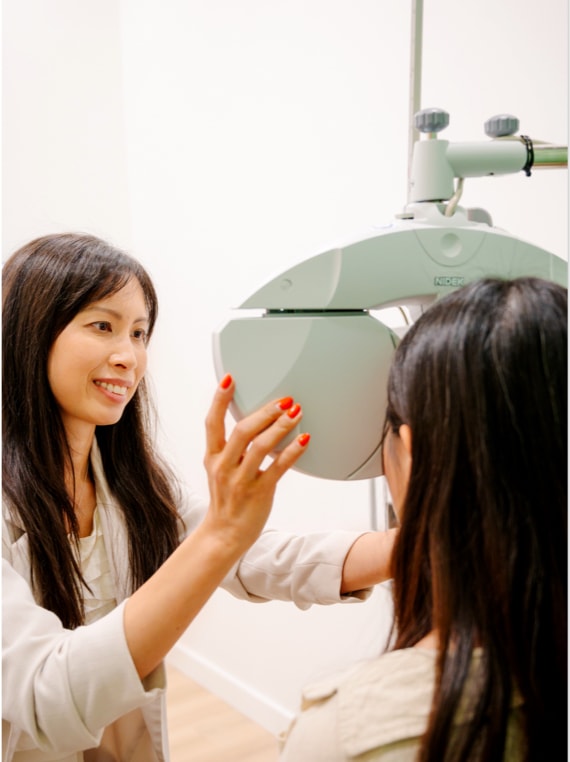
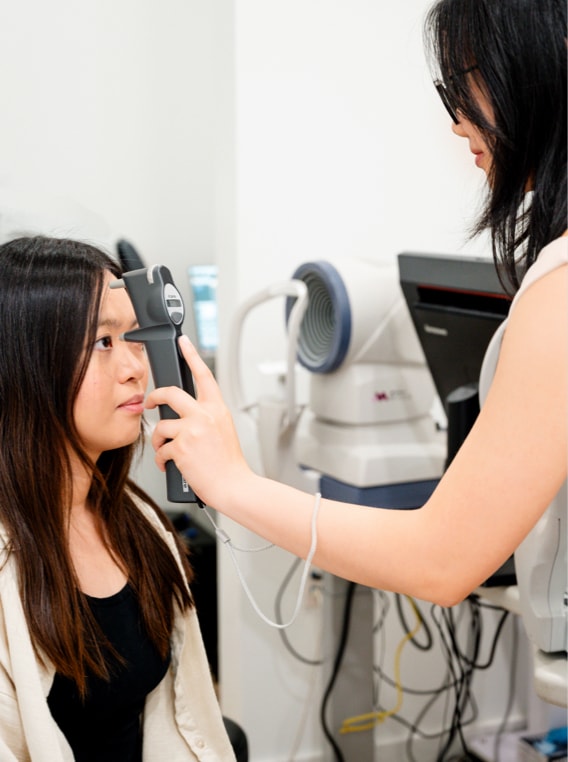
We use targeted technology to monitor for signs of myopia in children and keep an eye on their progress during treatment. We use the Topcon MYAH device primarily for our myopia management measurements.
The MYAH can measure the axial length, which is the length of the eye from front to back. Measuring the axial length gives us valuable information about your child’s eye growth, especially when monitored over time.
We compare their eye growth trends to the rate of expected growth for their age group. This can indicate whether myopia is present and the rate at which it’s progressing. It also allows us to monitor the efficacy of your child’s myopia treatment.
The MYAH device can also perform corneal topography measurements, which map the shape of your child’s cornea to fit contact lenses.
Healthy Habits for Young Eyes
While the exact causes of myopia are still unknown, a variety of risk factors are connected to increasing the likelihood of developing myopia in childhood.
We recommend reducing screen time for children to less than 2 hours of leisure time per day, with lots of breaks. Instead, encourage your children to spend more time outdoors. Not only can outdoor time help slow the progression of myopia, but it’s also great for general health. If you’re able, join your child outside for a walk, bike ride, or just to play in the park. It’s good for your eyes as well!
Finally, healthy eyes require nutrients. Encourage your child to eat well-balanced meals with different fruits and vegetables to get all their important vitamins.
Myopia Control Begins with Diagnosis
The first step to protecting your child’s eyes from myopia progression is detecting it. The earlier we can diagnose myopia in your child, the more effective the treatment can be. Regularly scheduled eye exams help us monitor your child’s ocular health from an early age.
By starting myopia control early, we can slow its progression and prevent it from worsening as significantly as without treatment. This means your child’s vision will be less impaired by the time they reach adulthood, which reduces their risk of eye diseases such as myopic maculopathy, cataracts, and retinal detachment.
It also means they may be less dependent on vision correction; for example, they can wake up and read their alarm clock without glasses. And, should they explore laser eye surgery in the future, they’ll have a better chance of being a good candidate.
Changes to your child’s vision and eye length due to myopia cannot be reversed once they happen. By proactively treating myopia as soon as it’s detected, you’re setting your child up for healthier eyes in the future.
Request Appointment




Our Eyewear Brands





Visit Our Location
We’re located in Wilshire Plaza just off Bathurst Street and New Westminster Drive. There’s plenty of parking available.
Our Address
- 8020 Bathurst St, Unit 4A-2, Building B
- Thornhill, ON L4J 0B8
Contact Information
- Phone: 905-889-2940
- Email: tvc@thornhillvisioncare.ca
Hours of Operation
Our Google Reviews

What Our Patients Are Saying
“I have had a wonderful experience with Dr. Yi and her team. They are knowledgeable, friendly, and always make me feel at ease. When I come here for my eye exams and contact lens fittings, I know my eye health is in good hands!”
Maria R.
“I had such an amazing experience with Dr. Clara Yi. She was extremely helpful and was so kind. All the staff were also very welcoming and helpful. I highly recommend coming to this clinic for any vision needs!”
Sofia S.
Simon
Julia K.
Oleg D.
Gallery



Thornhill Vision Care
- 8020 Bathurst St, Unit 4A-2, Building B
- Thornhill, ON L4J 0B8
- Phone: 905-889-2940
- Email: tvc@thornhillvisioncare.ca